

Good Product
Good Product - Sustainable Future
We concentrate on reducing our environmental impact by adopting innovative solutions, resource-efficient manufacturing practices and circular solutions.
Climate impact
Taking action to combat climate change is one of the greatest challenges of our time. To tackle this challenge, we need to reduce greenhouse (GHG) emissions.
At TePe we aim to continuously reduce our GHG emissions throughout the life cycle of our products and business activities. This is an ongoing journey. We are guided by Agenda 2030 and the United Nations Sustainable Development Goals (UN SDGs), especially seven of them, in areas where we can make the biggest difference. We take a holistic approach to sustainability, including environmental, economic, and social aspects.
Several of the SDGs concern climate action, GHG emissions and resource efficiency. Therefore, and based on our materiality analysis, we have made it one of our priorities to reduce our GHG emissions.
Shifting to renewable materials
Shifting to renewable materials
Since materials are an area within our control, we are shifting to more sustainable raw materials in our production.
Shifting to renewable/recycled packaging
Shifting to renewable/recycled packaging
We are increasing the share of sustainable materials in packaging, with the aim that 100% of our packages should include renewable, recycled or FSC certified packaging materials in 2025, as well as improving packaging recyclability. New packaging is optimised for transport and dimensioned to fit pallet sizes.
Using renewable energy
Using renewable energy
We use renewable energy and increase energy efficiency across our business. Our initiatives include upgrading our manufacturing equipment and cooling systems and making our buildings more energy efficient, utilising as much heat as possible from production. We have also invested in our own rooftop solar power plant.
Finding sustainable transport options
Finding sustainable transport options
We are prioritising shipping by boat over air freight and are looking into further efforts to lower the impact of shipments to and from the factory.
Innovative production
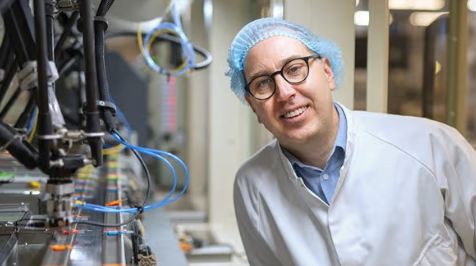
In a dialogue with Ronnie Sik, TePe's Operation Innovation Manager, we explore the benefits of having production, research and development all under one roof. TePe's commitment to sustainable innovation within its state-of-the-art production facilities is the focal point. It highlights the balance between sustainability, innovation and economic pragmatism that characterises TePe's manufacturing approach.
Ronnie Sik has supported our production site at TePe as the Technology Manager for over a decade. In 2023, he entered a new role at TePe as the Operation Innovation Manager. Together with a team of engineers and technicians, he supports innovation within the production, with a commitment to sustainability and resilience.
- At TePe’s production site, we emphasize renewable energy and a reuse, reduce and recycle approach. We strive to combine economic considerations with environmental sustainability, recognizing that actions benefiting the environment often also led to positive economic impacts, says Ronnie Sik.
A crucial aspect of the goal of ensuring machine resilience involves using the same machine for different product types, adapting it to evolving demands.
In our ongoing efforts, we’re concentrating on digitalising our labelling process on packaging. We reduced material use and improved recyclability by
switching from paper labels to engraving barcodes directly onto our packaging using a laser system.
As Ronnie puts it: "It’s about optimizing every aspect of our operations. A holistic perspective is needed to understand how seemingly small changes can lead to significant environmental benefits."
The strategic choice of Malmö in Sweden as the location for TePe’s production provides advantages for sustainable production practices, as highlighted by Ronnie.
"Having ownership of the operations enhances the synergy between sustainability goals and operational efficiency."
Putting sustainability into practice
An interview with TePe's Product Development Manager
We talked with Karl-Johan Grudemo, Product Development Manager at TePe, about material choices and reducing the carbon footprint.
Karl-Johan, how does the choice of plastics fit in with TePe’s sustainability journey?
Karl-Johan, how does the choice of plastics fit in with TePe’s sustainability journey?
"Plastic is simply outstanding in terms of application, quality and hygiene. That’s why we still use it in our products. To lower our environmental footprint, we’ve focused a lot on phasing out fossil raw materials and shifting to bio-based plastic. But we’re also looking at other ways of reducing the carbon footprint of our products and packaging, such as using new techniques and material combinations. It’s an exciting area with a lot of development going on."
What’s been decisive in TePe’s sustainability journey from your point of view as a product development manager?
What’s been decisive in TePe’s sustainability journey from your point of view as a product development manager?
"Working efficiently without unnecessary waste and respecting people and resources is part of TePe’s DNA. In 2018 we launch a toothbrush made from bio-based plastic. With the positive feedback on that product, and the fact that sustainability came higher on the agenda, it only felt natural to integrate renewable or recycled materials into our product development process and phase out fossil materials altogether."
Why did you focus on materials?
Why did you focus on materials?
"When we started looking at the whole lifecycle of our products, it became obvious that the choice of materials was the most relevant factor in reducing our carbon footprint. And at the same time, technical development made it possible for us to take big steps forward in terms of trying out new and bio-based solutions."
And then there’s the issue of what happens to the products after use. What can you say about that?
And then there’s the issue of what happens to the products after use. What can you say about that?
"It is a complex question. Even if we assume, worst case scenario, that our products will be incinerated after use, it doesn’t mean that they actually go to incineration. Incineration generates energy, but it also releases carbon dioxide emissions. However, using bio-based plastic as much as possible will reduce the net add of fossil carbon dioxide."
"Also, plastic ending up in the environment is a huge problem. There are however several projects within the plastics and recycling industries to make upcycling more widespread. But it will take significant investments, energy, commitments and political initiatives to accelerate this shift – a single company can’t make it happen."
From a carbon footprint point of view, what else is TePe focusing on, looking at the here and now?
From a carbon footprint point of view, what else is TePe focusing on, looking at the here and now?
"Parallel to the development of more sustainable materials, we make efforts to increase energy efficiency and lower the environmental impact of transport. For example, we have scaled up the transition from air to sea freight. We also strive to reduce materials and increase the recyclability of our packaging to reduce the footprint of waste. And taking part in initiatives and research projects to explore new and better recycling solutions and materials is crucial."
"Sustainability ad circularity are complex matters, so it is important to keep discussing and communicating these questions in a transparent way. We learn and develop every day and constantly strive to put this knowledge into practice. That’s challenging, but also very rewarding – it’s a great feeling to be able to offer people more sustainable choices in everyday life."
Recyclable and renewable solutions
At TePe we are continuously investigating and implementing ways of reducing the carbon emissions of products and packaging, applying an overall view including their whole life cycle. TePe now source 100% of raw materials for the toothbrush- and interdental brush handles from either renewable feedstock* or certified renewable sources via the mass balance approach, independently certified by ISCC PLUS.
What happens to the product after use, the question of waste management, is constantly relevant. This is one of the biggest challenges, that producers must facilitate recycling for consumers both by design and correct information.
Packaging has its own challenges. It has the important function to protect the product during many stages, right up to storage at home. But the fact remains that it will become waste when it has served its purpose for the consumer.
At TePe, no decisions are made without sustainability in mind. It is important to remember that sustainability is about all three aspects, and we must continue to have a holistic perspective. Our sustainability work will continue to intensify – there will always be areas of improvement and new matters to address.
*TePe Choice™ toothbrush, made with a reusable wooden handle, and TePe GOOD™ toothbrush handle made with materials sourced from sugarcanes.
Materials
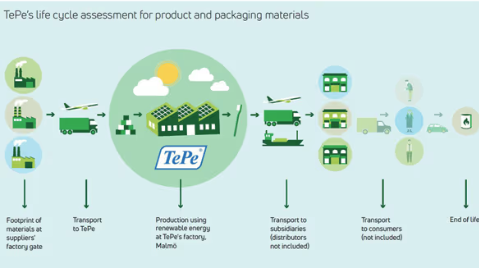
TePe monitors the emissions of the purchased materials for our self-produced products and packaging by implementing a life cycle assessment (LCA) methodology per ISO 14040 and 14044. The assessment shows the most critical factors in reducing the carbon footprint, and includes materials, energy, transport and waste management. With that, plastic has its benefits and its challenges. It is outstanding in terms of application, weight, quality and hygiene. We are convinced that plastic has its place in modern society, though with a more circular approach than today.
Other critical factors identified by the life cycle assessment concern transport and end-of-life. In 2023, we continued our efforts to transition from air to sea freight. We have an ongoing project aimed at optimising shipments to and from the factory. Affecting the footprint from end-of-life is the most challenging part, to affect since it is a matter of waste-handling at various markets. However, we are working with stakeholders to explore new and better circular solutions.
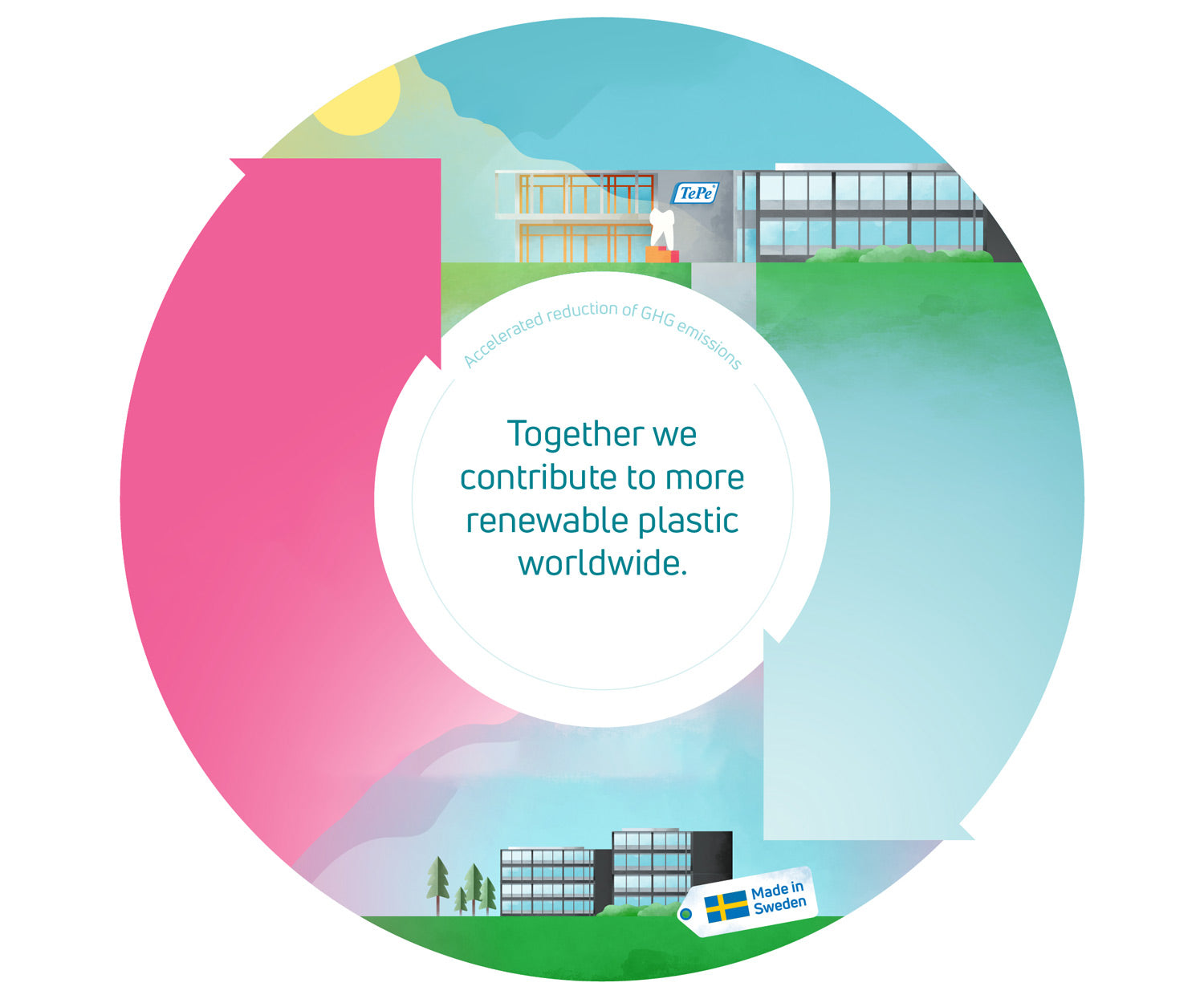
TePe buys 100% renewable plastic.
TePe's products keep the same high quality.
Our suppliers produce and sell a mix of fossil and renewable plastic to TePe.
Accelerated reduction of greenhouse gas emissions and a shift toward more circular solutions.
Packaging
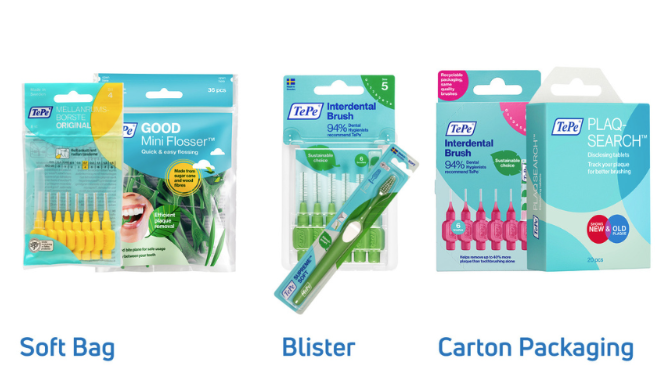
Packaging must withstand transport and storage in both stores and at home. Therefore, in development and proactive decision-making, many parameters must be evaluated – from user requirements and market demands, to aspects relating to regulations, safety and the environment. We carefully consider the material itself as well as the volume of materials required for our packaging. Our ambition is to reduce packaging wherever feasible. The aim is for 100% of the packaging for self-produced products to include renewable, recycled or FSC-certified materials in 2025. In 2023 we were at 77%. We are gradually changing our packaging to approach this goal by introducing more renewable and recycled materials and by introducing plastic-free packaging on some products and in some markets.
