

Prevention starts between the teeth

Interdental cleaning is essential for oral health because dental plaque accumulates most readily in the spaces between teeth—areas that toothbrushing cannot adequately reach. If interdental plaque is not disrupted daily, it promotes gingival inflammation and increases the risk of gingivitis and periodontitis, which are leading causes of tooth loss in adults.
Systematic reviews and meta-analyses consistently show that adding interdental cleaning to toothbrushing results in greater reductions in gingival inflammation than toothbrushing alone, with evidence supporting interdental brushes as particularly effective at reducing both plaque and gingivitis. ¹, ²
By mechanically disrupting the interdental biofilm, interdental cleaning plays a critical role in preventing periodontal disease and supporting long-term oral health.
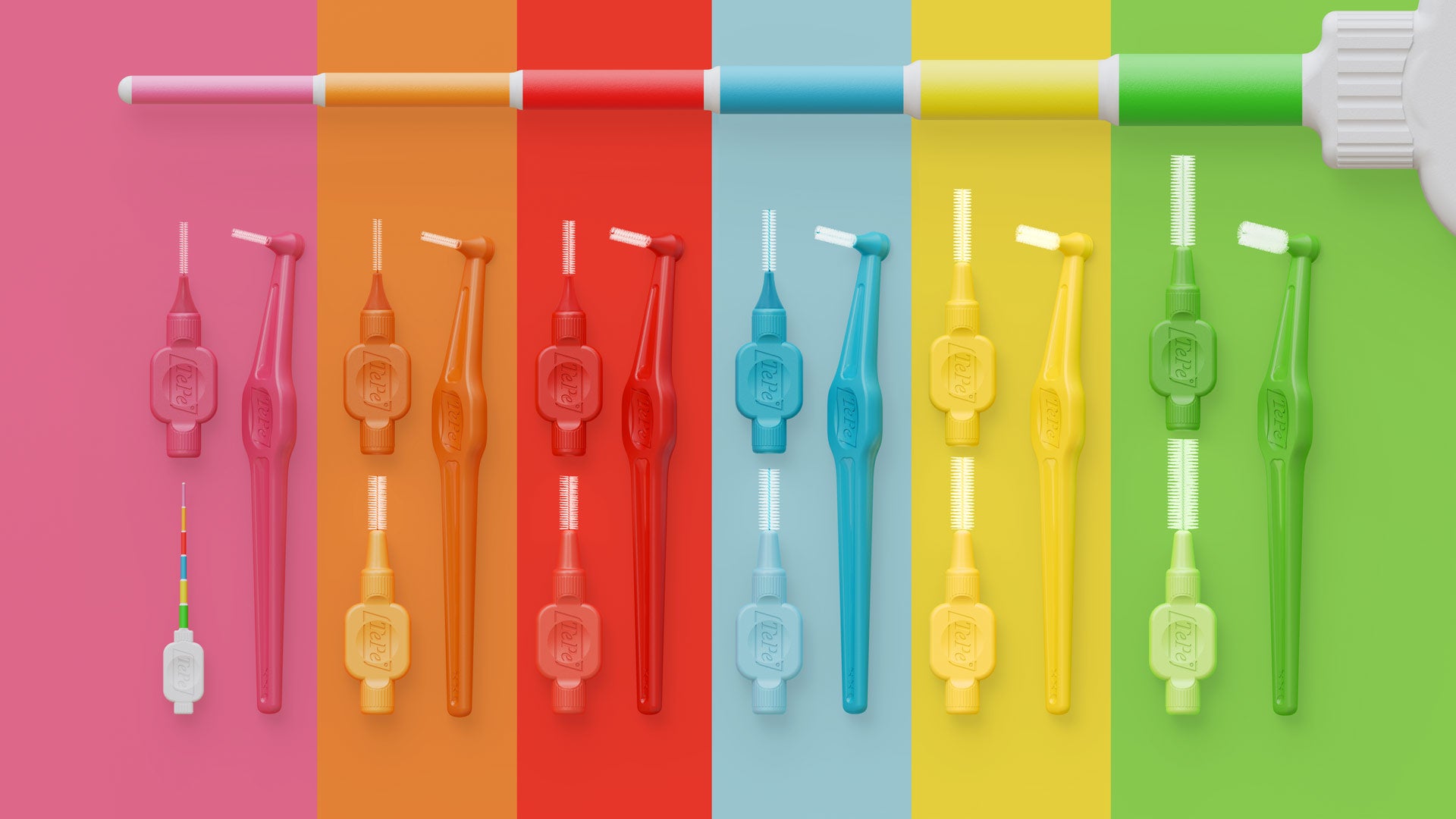
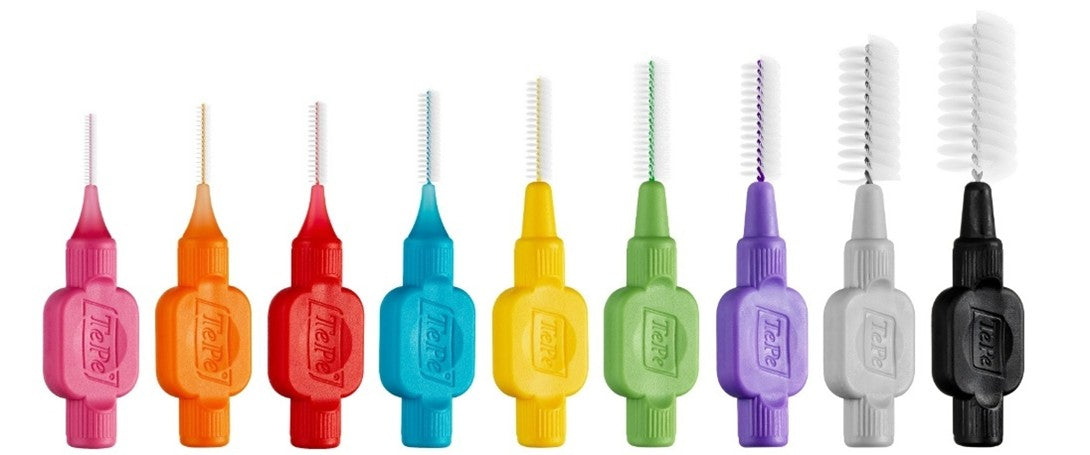
Every mouth and space between the teeth is different; that’s why dental professionals know one size interdental brush does not fit all spaces.
TePe offers 9 different sizes of interdental brushes.
A perfect fit:
- Bristles uniformly touch all interproximal grooves and depressions
- Brush circumference is slightly larger than embrasure space
- Bristles should fit snugly with some resistance when passing through
- Bristles extend under the contact point
Key Benefits:
- Helps identify the correct interdental brush size for each space
- Supports more effective plaque removal and gum health
- Easy-to-use, gentle, and hygienic single-use design
- Improve long lasting oral health results
How to Use the Size Finder
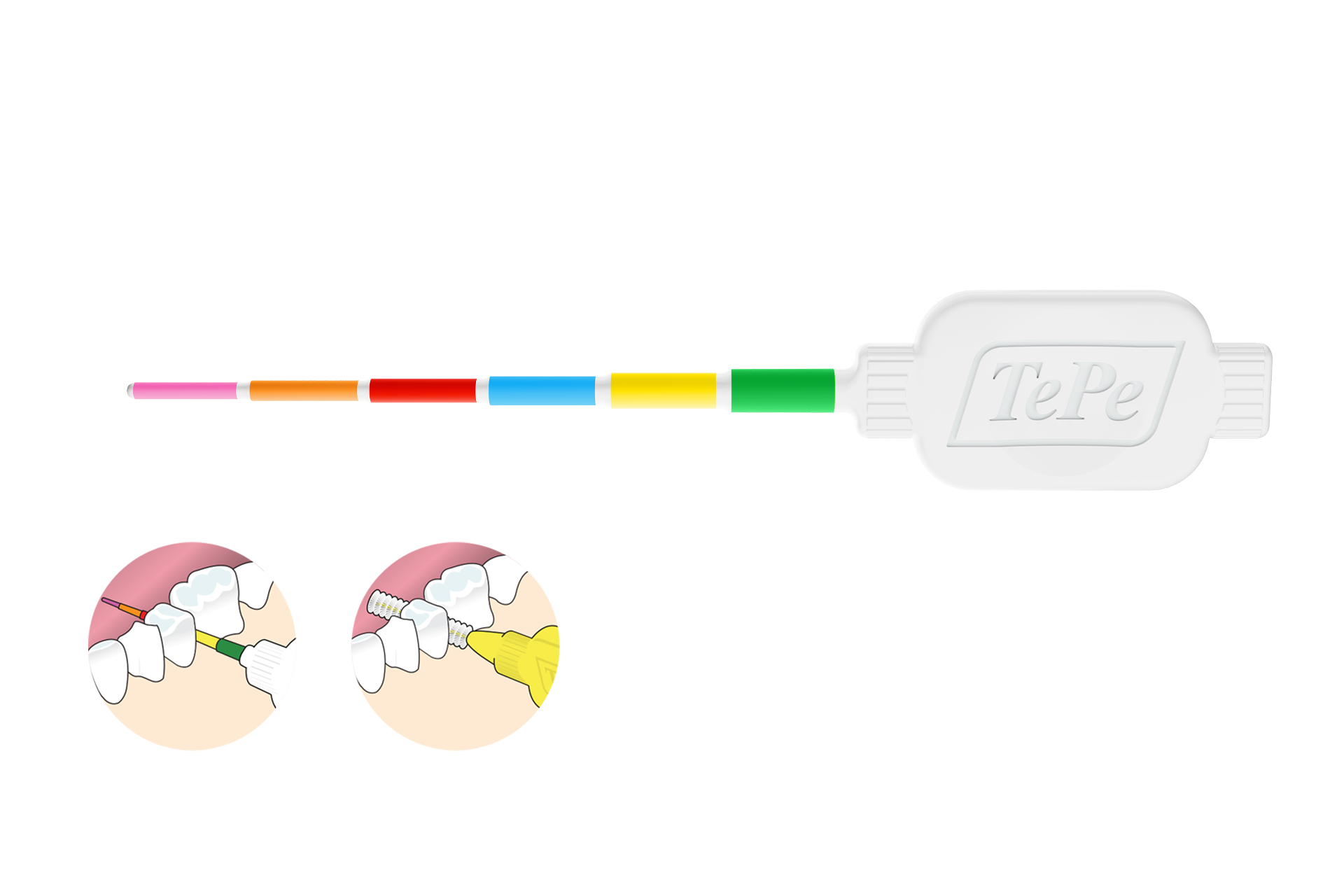
- Carefully insert the TePe Size Finder™ until you feel a final resistance. The size is indicated by the color nearest the tooth surface.
- TePe Size Finder™ quickly guides you to the suitable TePe interdental brush size! If the TePe Size Finder™ passes through entirely, colors purple through black are recommended. If it cannot be inserted, color pink or dental floss is recommended to use.

Other Ways to Size Chairside
There are other convenient ways to assist you with guidance towards the correct color interdental brush size for your patient. Remember, this is an estimation, and we recommend you verify the perfect fit by using the interdental brush in your patient's mouth to confirm.

Using Your Probe as a Sizing Indicator
Most probes are equivalent to TePe’s blue interdental brush. Insert the probe horizontally through the embrasure space.
- If the probe does not pass through: sizes pink,orange, red
- If the probe passes through while lightly touching the teeth: size blue
- If the probe passes through without touching either tooth: sizes yellow, green, purple

Using a Visual Guide for Sizing
This guide offers visual guidance on the size of the embrasure space with the corresponding TePe interdental brush.
- A quick guide to visualize interdental space with the correct TePe interdental brush.
- Offers an easy reference guide for both the clinician and patient

Using TePe EasyPick™ as a Reference Point for Sizing
Each of the TePe EasyPick™ sizes corresponds to the ISO sizes of the
TePe® Interdental Brushes. This is only an estimation and we recommend you
to check by using an interdental brush to confirm the best fit for your patient.
- TePe EasyPicks come in dispenser boxes available to purchase for patient distribution
- TePe EasyPick can be used for a dual purpose of sizing and interdental cleaning on-the-go

How to Use an Interdental Brush
- Use once a day, preferably in the evening.
- To prevent your interdental brush from bending or distorting when you initially insert between teeth, slightly wiggle or do a quarter-turn.
- Once you are completely inserted between teeth, move the brush back and forth a few times in a horizontal motion.
- Rinse with water and let air dry.
- Replace once the bristles start to collapse.



Get Started Today with Your Chairside Recommendation
We know that floss is difficult to use, and our patients often need an alternative, with interdental brushes being highly effective. We also know that in the United States nearly half of our adult patients have periodontitis.
With a conservative approach, TePe would recommend approximately half of your patients would need interdental brushes. Because spaces vary throughout the mouth, we recommend on average 2 interdental brushes for each patient.
*If you are working at a periodontal office, where most patients have a reduced periodontium, all of your patients would benefit from interdental brushes.
Stocking Your Office with Interdental Brushes
Formula: 50% of patients using an interdental brush + 2 interdental brushes for each of those patients = number of interdental brushes (seeing 8 patients per day)
Using this Chart, Find How Many Interdental Brushes You Would Need Per Week in a General Practice
Select the number of hygienists and working days to estimate weekly interdental brush needs.
| # of days of the week working | |||||
|---|---|---|---|---|---|
| # of Hygienists | 1 | 2 | 3 | 4 | 5 |
| 1 | 8 | 16 | 24 | 32 | 40 |
| 2 | 16 | 32 | 48 | 64 | 80 |
| 3 | 24 | 48 | 72 | 96 | 120 |
| 4 | 32 | 64 | 96 | 128 | 160 |
| 5 | 40 | 80 | 120 | 160 | 200 |
Values are estimates based on seeing 8 patients a day, with 50% needing an interdental brush and 2 interdental brushes for each of those patients.
TePe offers multiple options to stock your office

Practice Box - TePe Interdental Brush Original
Contains 120 interdental brushes in 9 color-coded sizes to effectively clean the many different sized spaces between teeth. When your stock runs low, you can restock the single color with a 25-pack.

Practice Box - TePe Angle™
Contains 52 interdental brushes in 6 color-coded sizes, with a longer handle to reach back teeth or for those with poor dexterity. When your stock runs low, you can restock the single color with a 25-pack.

TePe Interdental Brush Orginal (36 pack)
Each brush is individually wrapped with information and a discount code for the patient. There in one color in each box.

TePe Angle™ (80 pack)
Each brush is individually wrapped with information and a discount code for the patient. There is one color in each box.
FAQ
What should I recommend to clean between the teeth?
What should I recommend to clean between the teeth?
Many reviews have been conducted to evaluate different interdental devices to clean between the teeth. Below are some points to consider when choosing your tool.
- Shape of the area needing plaque removal
- Level of dexterity
- Technical difficulty of the task
- Ease of use of the device
- Your motivation
The different tools available to clean between your teeth.
In a network meta-analysis completed by Kotsakis et al. (2018) comparisons were made among different methods of cleaning between the teeth. This type of research explored 22 studies that met specific criteria, and then an analysis was completed to draw comparisons among different interventions used for plaque disruption between the teeth. This review explored research on the following methods:
- Flossing
- Powered flossing
- Toothpicks
- Toothpicks with intensive oral hygiene instructions
- Water jet irrigation devices
- Interdental brushes
- Gum massaging devices
- Toothbrush only
- Powered toothbrush
- Powered toothbrush and waterjet
In conclusion interdental brushes displayed the best result regarding reduction in gum inflammation, plaque reduction, and pocket reduction. The authors did however state that devices need to be based on individual and clinical needs.
Reference:
Kotsakis, G. A., Lian, Q., Ioannou, A. L., Michalowicz, B. S., John, M. T., & Chu, H. (2018). A network meta-analysis of interproximal oral hygiene methods in the reduction of clinical indices of inflammation. Journal of periodontology, 89(5), 558–570. https://doi.org/10.1002/JPER.17-0368
When do I recommend floss?
When do I recommend floss?
When to use floss:
- Gum tissue fills the area between the teeth. When you have healthy teeth and gums, there are less grooves and depressions of the natural tooth exposed. This means floss can adequately reach the interproximal surfaces and do a sufficient job at disrupting the plaque. There is also papillary guidance when cleaning each surface of the tooth.
- Good dexterity. Flossing requires moving your hands inside your mouth and ensuring the floss reaches the right spots without harming your gums. It takes skill to make these small movements.
- Ability to open and get hands inside the mouth. If you have large or shaky hands, this can make flossing a struggle. You need to be able to adequately open and reach all areas.
- Ability to complete the skill of flossing. Flossing is technique sensitive and takes time. The effectiveness relies on you reaching every spot. Below are more directions on using string floss.
- High motivation. The skill of flossing takes time to master, so you must be highly motivated. If you are rushed, your technique may be comprised. This could lead to using floss incorrectly, which could be less efficacious or harm your gums.
How many brushes should I purchase to hand out chairside?
How many brushes should I purchase to hand out chairside?
Think about the type of patients you commonly see, and this will determine how many brushes you need to keep in stock for samples.
- Pediatric
- Orthodontic
- Implant
- Periodontitis
- Healthy
Here are our suggestions for a perio practice and general practice seeing 8 patients per a day. This suggested quantity will last you 3 months.
Perio Practice: 8 patients per day and 2 IDBs per patient with 100% of patients needing brushes
Quarterly 1 hygienist, 1 day a week = 192 brushes
- Eight 25 packs
- Six 36 packs
- Quarterly 1 hygienist, 2 days a week = 384 brushes
- Sixteen 25 packs
- Eleven 36 packs
Quarterly 1 hygienist, 3 days a week = 576 brushes
- Twenty-three 25 packs
- Sixteen 36 packs
- Quarterly 1 hygienist, 4 days a week = 768 brushes
- Thirty-one 25 packs
- Twenty-two 36 packs
General Practice: 8 patients per day and 2 IDBs per patient with 50% of patients needing brushes
Quarterly 1 hygienist, 1 day a week = 96 brushes
- Four 25 packs
- Three 36 packs
Quarterly 1 hygienist, 2 days a week = 192 brushes
- Eight 25 packs
- Six 36 packs
Quarterly 1 hygienist, 3 days a week = 288 brushes
- Twelve 25 packs
- Eight 36 packs
Quarterly 1 hygienist, 4 days a week =384 brushes
- Sixteen 25 packs
- Eleven 36 packs
What patient support tools does TePe have available?
What patient support tools does TePe have available?
TePe Offers you many different tools to assist with homecare compliance.
Patient Support Tools
- TePe Illustrator Interdental Care: Use this to show how teeth have grooves and depressions between the teeth. This is a comparison of a rubber bristle brush, an interdental brush, and floss accessing the surfaces between the teeth to remove plaque. Introduce patients to different interdental homecare options, there is a QR code for patients to view educational videos.
- TePe Illustrator Specialty Brushes: Use this to show patients which specialty brush you are recommending, along with pictures and illustrations. There is a QR code for patients to view educational videos.
- TePe Customized Care Plan: Collaborate with your patient to create a plan for homecare. Customize which interdental brush size and notate where to use on the dental arch illustration. Make a plan for habit change using the formula: Cue + Routine = Identity. On the back select which products you suggest for an optimal homecare routine.
- TePe Patient Order Form: You can download this form for patients that want to mail in their purchase. Indicate which products they need, and then the patient will send in with payment information.
- Patient Product Guides: Print these guides and give to your patients. Each guide discusses what the product is and how to use it.
- Patient Leaflets: TePe offers 7 different leaflet options that provide information on specific situations.
- Caring for your healthy smile
- Caring for your gums
- Caring for your children’s teeth: 0-6 years
- Caring for your children’s teeth: 6+ years
- Caring for your braces
- Caring for your gums in your senior years
- Caring for your implants
- TePe Digital Recommendation: This is a digital web-based platform. You can use the “media” section to easily access all patient support tools chairside. You will need to create a username and password.
ISO Size of Brush and Corresponding PHD
ISO Size of Brush and Corresponding PHD
When it comes to sizing an interdental brush, you may have come across many different terms on packaging and in continuing education courses. These different methods are there to offer guidance, but remember the key attributes.
A perfect fit:
- Bristles uniformly touch all interproximal grooves and depressions
- Brush circumference is slightly larger than embrasure space
- Bristles should fit snugly with some resistance when passing through
- Bristles extend under the contact point
Here are the different ways manufacturers create a size range of interdental brushes.
International Organization of Standardization (ISO): ISO standard 15409 “Dentistry—Oral hygiene products—Manual interdental brushes” was created in 2006, and then it was revised in 2016. This standard defines what an interdental brush is and its components. Within this standard Passage Hole Diameter (PHD) is defined and used to create a brush size index to cover the many different types of spaces between teeth. Quality testing is also integrated to ensure absence of defects, bristle retention, and core retention.
Passage Hole Diameter (PHD): The ISO standard defines this as the “minimum diameter through which a brush head can pass (using a clinically relevant force) without deforming the shaft.” The shaft is referring to the wire core of the interdental brush. There are many different aspects that can influence the PHD that include properties of the central wire core and the bristles.
Size of Brush Passage hole diameter (in mm)
- ISO 0 is < 0.6mm PHD
- ISO 1 is 0.7-0.8mm PHD
- ISO 2 is 0.9-1.0mm PHD
- ISO 3 is 1.1-1.2mm PHD
- ISO 4 is 1.3-1.5mm PHD
- ISO 5 is 1.6-1.8mm PHD
- ISO 6 is 1.9-2.3mm PHD
- ISO 7 is 2.4-2.8mm PHD
- ISO 8 is > 2.9mm PHD
Brush Diameter: This is the total length of the brush in the cross-section. For a cylindrical brush this is the same from the base to the tip. For a conical brush, the diameter is greatest at the base and gets smaller at the tip. The total brush circumference should be slightly larger than the embrasure space, so the bristles can effectively reach all grooves and concavities.
Wire Diameter: This is the total length of the wire core in the cross-section. This would also include any coatings on the wire core.
Individual Bristle Diameter: Staehle and Sekundo (2025) noted that an early study by Wolff et al from 2006 showed that individual bristle diameter had less influence on plaque removal that the overall diameter of the brush head, but it can impact handling (easy or difficult to pass through interdental space). There needs to be more research to understand the significance of the relationship between bristle diameter and length.
Shorter and thicker bristle = higher cleaning effectiveness and lower reach
Longer and thinner bristle = lower cleaning effectiveness and higher reach
There needs to be a favorable ratio between length and thickness to provide effective, gentle cleaning.
Reference:
Wolff, D., Joerss, D., Rau, P. et al. In vitro cleaning efficacy and resistance to insertion test of interdental brushes. Clin Oral Invest 10, 297–304 (2006). https://doi.org/10.1007/s00784-006-0068-x
Staehle HJ, Sekundo C. History of Interdental Brushes: Origins, Developments, Perspectives. Oral Health Prev Dent. 2025;23:1-20. Published 2025 Jan 8. doi:10.3290/j.ohpd.c_1800
When would I recommend the TePe black interdental brush?
When would I recommend the TePe black interdental brush?
TePe’s black interdental brush is TePe’s largest brush.
- Missing Teeth or Diastema: It is great when there are missing teeth. When inserting from the buccal, you can reach all proximal surfaces and line angles.
- Post Implant Placement: It is also great to use after implant placement to clean adjacent tooth surfaces and visible abutments. You would use for approximately 3-6 months while the implant is Osseo integrating, before the restoration is placed.
How often should you use an interdental brush?
How often should you use an interdental brush?
Like all interdental cleaning, we recommend at least once a day in the evening.
How long does each interdental brush last?
How long does each interdental brush last?
After each use, rinse and let your interdental brush air dry. Each brush will wear differently depending on the size of brush, how many embrasure spaces you are using it in, how many times a day you are using, and how much force you are applying. We recommend changing the brush once the bristles have collapsed or become one with the wire, because then the bristles cannot reach all the interproximal areas.
You can always have a good starting point for your patients, but remind them to observe their brush to see if they need to replace more or less frequently.
- Pink, Orange, and Red: Replace every week
- Blue, Yellow, Green, and Purple: Replace every two weeks
- Gray and Black: Replace every three to four weeks
How many interdental brushes per patient?
How many interdental brushes per patient?
Different interdental spaces in the mouth may need different sizes. You must also consider prosthetics, implants, and orthodontics. On average, each patient will need at least two different sized brushes. This is an individualized recommendation, so if your patient is motivated, you can of course recommend more than two.
Who should I recommend interdental brushes to?
Who should I recommend interdental brushes to?
Many people think flossing is the best tool, but there are alternatives. Internal brushes have shown to be a superior method related to high plaque removal, reduction in gum inflammation, and are often easier to use. Unlike floss, the interdental brush can reach all the grooves between your teeth. When sized appropriately, the bristles of an interdental brush reach all the concavities of the tooth, especially on a reduced periodontium
Here are reasons why you might choose an interdental brush:
- Easier to use, especially for people with limited hand and finger dexterity
- More compliance and takes less time
- Effective between two natural teeth
- Effective for those with periodontitis, which means more grooves that the bristles of the interdental brush can get into
- Effective for getting under orthodontic wires and around braces
- Effective in hard-to-reach areas, for example under bridges, around implants and crowns
Do interdental brushes cause trauma?
Do interdental brushes cause trauma?
TePe’s interdental brush wire core is looped on the end to prevent trauma. Studies have shown no correlation with the use of the interdental brush with soft tissue damage (Waerhaug, 1976 & Bergenholtz, 1984).
Shrinkage and recession of the papilla after using an interdental brush where there is inflammation is due to the healing response and not adverse trauma.
It is important that your patient is sized appropriately and the correct technique is being used to prevent any unwelcomed tissue harm.
Does an interdental brush reach below the gumline?
Does an interdental brush reach below the gumline?
When using a cylindrical brush and passing through the interdental space with its wire core at the gingival margin, the length of the bristle from the metal core determines the potential for subgingival reach.
What is the difference between original, angle, and extra soft interdental brushes?
What is the difference between original, angle, and extra soft interdental brushes?
We offer three different interdental brush options that provide different bristle textures and different handles. It is the same wire diameter across all three lines for each specific color. Also, the wire is plastic coated, safe to use around implants and prosthesis. The original line has nine color-coded sizes, a short broad handle, flexible tip on the four smallest sizes for better posterior access, and you can use the cap as an extra extension in length. The extra soft line has 6 color-coded sizes with very soft bristles for delicate or sensitive oral tissue. The angle line has 6 color-coded sizes. The handle and brush are one piece and do not separate. The brush is set at a 90-degree angle to the handle.
References
Sources and references
The statistics and claims on this page are supported by the following sources.
